
1. Hydrological scale
The runoff/infiltration blance for a given rainfall event and for each cell i is carried out using an hydrological balance, called HBi (mm) which is defined according to the following equation (Cerdan et al., 2002) :

With :
Pi : total rainfall for the event (mm)
IMBi : imbibition (mm)
ICi : infiltration capacity (mm/h)
teff : effective duration (min)
A positive value of HBi corresponds to runoff noted Ri (mm) (or net rainfall available for the runoff). If the value is negative, HBi corresponds to a potential reinfiltration value (mm) for runoff from upstream. The value of HBi is weighted by the parameter θ, to take into account the scale effect associated with the resolution of the DTM used.
Potential reinfiltration is limited by the maximum water storage capacity of the soil, known as WSi (mm) :

By introducing a maximum water storage capacity, the model is able to simulate soil saturation processes.
2. Runoff velocity
Equation (1) is valid for catchments of around ten hectares, where the duration of runoff can be considered to be identical to that of rainfall. For larger catchments, where the duration of runoff is higher, the use of this equation results in an underestimation of reinfiltration processes. To overcome this limit, the duration of runoff is calculated for each cell, by determining the velocity and time taken for runoff to pass through each cell.
The average intensity of the net rainfall ei (mm/h) is calculated according to the following equation:

On hillslopes, the runoff velocity is calculated using the net rainfall intensity according to the following equation:
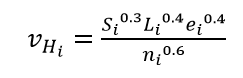
With :
vHi : runoff velocity on the slopes (m3/s)
Si : local slope (m/m)
Li : runoff distance per cell (m)
ei : net rainfall intensity (m/s)
ni : Manning’s coefficient (s.m-1/3 )
In streams, water velocity is calculated using the steady-state continuity equation for wide streams:
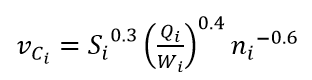
With :
vci : water velocity in streams (m/s)
Qi : cumulative upstream flow (m3/s)
Wi : full width of the stream (m)
The velocity values are bounded to a minimum of 0.02 m/s and a maximum of 2 m/s to avoid unrealistic values.
3. Runoff duration
The time taken to pass through each cell is calculated by dividing the water velocity by the flow distance:

With :
TTi : time taken to pass through the cell (s)
vi : water velocity on the slopes or in the streams (m/s)
The duration of the runoff corresponds to the time during which the water flows over the cell. It is assumed that the flow starts at the centroid of the rainfall and ends when the time of concentration has elapsed. The time of concentration (or reinfiltration time) is determined by summing the travel times of each cell, up to the cell with the furthest hydrological distance. The runoff duration equation is:

With :
TRi : runoff duration (s)
TCi : concentration time (s)
a : runoff duration contraction/dilation factor
The time of concentration can be adjusted using the parameter Theta so that the reinfiltration time can be adjusted. Following this calculation, the hydrological balance is determined for the duration of the rain and runoff :

The soil water storage capacity remains a limiting factor :

The hydrological balance of each cell is then accumulated from upstream to downstream, following the steepest slope gradient. The runoff is propagated downstream by successively filling all the cells with negative hydrological balance. For a given cell, when the volume of runoff coming from upstream is smaller than the potential reinfiltration volume, the runoff stops.
4. Schematic hydrograph
The water is routed with a triangular hydrograph, based on the runoff duration and the runoff volume accumulated on each cell. The resulting peak flow is calculated using the following equation :

With :
QPi : peak flow (m3/s)
Vi : runoff volume (m3)
TRi : runoff duration (s)

 WaterSed